News Details
Thriving while surviving: Understanding the social needs of cancer survivors

Authored by: Deborah Stull, Penn Today
Faculty & Research
08/11/25
SP2 researchers and their colleagues have investigated how unmet social needs impact the health and well-being of U.S. cancer survivors. Their findings are relevant for other serious chronic illnesses.
There is growing recognition of the important role that social needs such as access to food, housing, and transportation play in health care, as research has demonstrated their impact on physical and emotional well-being in a number of patient populations.
Now, in a study published in Current Oncology Reports, a collaborative team led by researchers from the School of Social Policy & Practice (SP2) has conducted a scoping review to determine what is known about the unmet social needs of U.S. cancer survivors.
“This is a neglected population,” says SP2 associate professor Tamara J. Cadet. She adds that while institutions have developed ways to celebrate the completion of treatment, and research has focused on the psychological needs of survivors—adjusting and coping—“there are also all these social needs that we know nothing about.” Understanding those needs, she says, is essential to developing effective interventions to address them.
“The goal is to compile the available evidence and present what the literature tells us on a topic,” says SP2 assistant professor Meredith Doherty. “[A scoping review] can help describe or map the landscape of what the scientific research on this topic looks like so that we can build from there.”
Analyzing data on a set of individual-level needs such as food security and housing from six databases, the researchers found that unmet needs, especially financial toxicity—the financial burden associated with chronic illnesses such as cancer—are prevalent among cancer survivors. Importantly, they also found that these unmet needs are negatively linked to quality of life, mental health, and adherence to care.
“Unmet social needs are associated with greater use of the emergency room, longer hospital stays, and people coming in with more advanced conditions—pain and uncontrolled symptoms—because they weren’t able to see a doctor earlier,” says Doherty.
“We know if we’re not addressing these needs, we’re going to have bad outcomes,” adds Cadet, who also has a secondary appointment in the School of Dental Medicine. “And we don’t want bad outcomes for people who’ve already conquered cancer.”
People
-
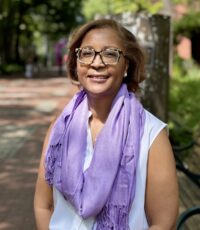
Tamara J. Cadet, PhD, LICSW, MPH
Associate Professor
Contact
office: 215.898.5501
fax: 215.573.2099
Email
-

Meredith Doherty, PhD, LCSW
Assistant Professor
Contact
office: 215.573.1169
Email
