News Details
Planning ahead in an age of longevity
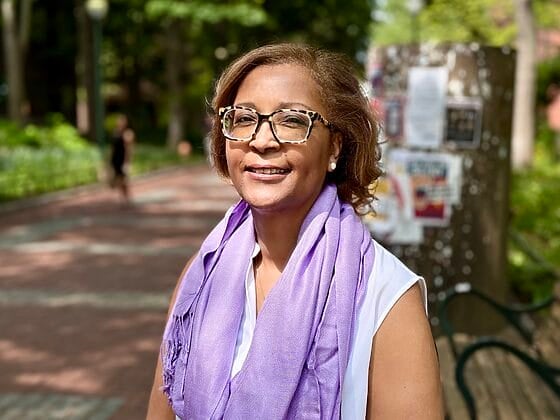
Authored by: Deborah Stull, Penn Today
Photography by: Carson Easterly
Faculty & Research
01/28/26
Tamara J. Cadet of the School of Social Policy & Practice discusses strategies for preparing — financially and physically — for an extended lifespan.
Life expectancy in the United States has been rising over many decades, ushering in what experts describe as “an era of unprecedented longevity.” This trend raises important questions about how people can best prepare for and navigate this extended lifespan.
Penn Today spoke with Tamara J. Cadet, an associate professor in the School of Social Policy & Practice and co-author of “Health and Wealth in the Era of Longevity,” a report from TIAA Institute and the Gerontological Society of America, about how Americans can chart a path toward healthy aging and well-being in later life.
Post-retirement planning should involve more than a discussion of finances
Traditionally, retirement planning focuses on finances—whether people have enough money to live “comfortably.”
Most retirement conversations start and end with money, says Cadet, who also has a secondary appointment in the School of Dental Medicine. “But that doesn’t consider all the other things that could happen in your world,” she says. “You can’t just focus on wealth or income. If you’re not healthy or you’re not preparing for that, then you’ve got a problem.”
Financial literacy, the knowledge and skills to make informed decisions about money, is essential. But Cadet and her co-authors say people also need to have “longevity literacy,” combining an understanding of life expectancy with financial literacy to appreciate why they are saving.
“People aren’t planning for the fact that they are living 10 to 15 years longer,” says Cadet. “And that’s a problem from a health perspective, because as we get older, our health may decline, and we may be at increased risk for falls and cognitive decline.”
Living longer should include living better
Health literacy is key to living better, says Cadet. According to the World Health Organization, health literacy is the ability to access, understand, appraise, and use information and services in ways that promote and maintain good health and well-being.
Older adults can start by asking their providers simple questions, says Cadet. She points to a tool from the Institute for Healthcare Improvement called Ask Me Three:
- What is my main problem?
- What do I need to do?
- Why is it important for me to do this?
She encourages older adults to think about how they want to feel physically as they age and to make small changes now to reach those goals.
“We want people to think about thriving, not just surviving,” she says. “But in order to thrive, you have to be ready, and in order to be ready, you have to be educated.”
Organizations also need to participate
But individual action is only half of the story, says Cadet. Workplaces and healthcare services must also adapt as unprecedented numbers of people live into their eighties and beyond.
“We are still a very ageist society,” she says. “But even simple things at the organization level could help,” offering larger fonts on hospital signs as an example.
Quoting from the report, Cadet says, “The longevity society requires focusing not only on the old but preparing the young for the challenges ahead.” The workplace, she adds, is an ideal setting to inform and educate adults to make informed choices about health, finances, and lifestyle for their lives after retirement.
“Most of us are working,” she says. “Work is the place to do that education.”
One possibility, she suggests, could be a pamphlet or decision aid tool for middle-aged adults that uses the life expectancy scales to show risks—financial, health, and social—all together.
The report concludes, “Health, financial, demographic, and social factors will inevitably pose challenges throughout life, but we can mitigate their impact by reshaping society to support an aging population and by promoting financial and longevity literacy.”
Tamara J. Cadet is an associate professor and co-director of the Ph.D. in Social Welfare program in the School of Social Policy & Practice with a secondary appointment in the Division of Community Oral Health at the School of Dental Medicine at the University of Pennsylvania. She is also a senior fellow in the Leonard Davis Institute and the Center for Public Health, director of the Program in Community Engagement Innovation at the Penn Center for Cancer Care Innovation, and assistant director for Community Outreach and Engagement at the Abramson Cancer Center.
Other authors are James C. Appleby, Ophira Bansal, Elana Kieffer Blass, and Lisa C. McGuire of the Gerontological Society of America; David Renkopf of Stanford University; David Hayes-Bautista of the University of California, Los Angeles; and Surya Kolluri and Anne Ollen of TIAA Institute.
People
-
Tamara J. Cadet, PhD, LICSW, MPH
Associate Professor
Contact
office: 215.898.5501
fax: 215.573.2099
Email
